
At COP: Why Credible Sustainability Leadership Starts from Within
As global leaders gather at COP31, attention is focused not only on climate ambition, but on the persistent gap between commitments and action. While countries have set out their climate ambitions through nationally determined contributions, translating these commitments into implementation remains a challenge, compounded by significant gaps in the financing needed to deliver them. The conversation is therefore increasingly centred on how ambition can be translated into meaningful, measurable progress.
While these challenges play out at the national and international level, the implementation question is equally relevant for businesses. Corporate climate commitments ultimately face a similar test of credibility: whether ambition can be translated into accountable governance, reliable measurement and operational decisions that deliver demonstrable progress.
For Univers, the credibility challenge takes on an added dimension. As we enable our customers to advance their sustainability ambitions and translate them into measurable action, we hold ourselves to the same expectations and apply the same discipline and rigour to our own operations, leading by example.
Our own sustainability journey has evolved alongside our business. Now in our fourth year of sustainability reporting, our FY2025/26 Sustainability Report reflects a more mature approach to managing sustainability, supported by stronger climate commitments, governance, responsible business practices and increasingly robust systems to measure and manage our performance. That is what sustainability leadership means to us: embedding sustainability into our operations and turning sustainability commitments into measurable action.
Turning Sustainability Commitments into Measurable Action
Turning sustainability ambition and commitments into measurable action requires more than setting targets. It requires governance that creates accountability, reliable data that makes progress measurable, and processes that embed sustainability aspects into how a business operates and makes decisions. This is where AI can help close the gap between sustainability ambition and execution. As sustainability management becomes more data-driven, AI multiplies an organisation’s capacity to process complex information and translate data into insights that support measurement, monitoring and decision-making. At the same time, using AI to create value responsibly requires appropriate governance over how it is developed and applied.
At Univers, our approach combines clear sustainability commitments with the governance, actions and systems needed to put them into practice. Our science-based net-zero targets, validated by the Science Based Targets initiative in 2025, commit Univers to achieving net-zero greenhouse gas emissions across our value chain by 2040. In alignment with these commitments, we have maintained 100% renewable electricity across our operations since 2023 through renewable electricity procurement and energy attribute certificates (EACs). Beyond climate action, we strengthened supplier due diligence and engagement, continued developing our people through expanded learning opportunities, and enhanced cybersecurity practices. As the use of AI continues to grow across our organisation and solutions, we also launched an AI Governance Programme to strengthen how AI is governed and used responsibly within the business.
Lastly, embedding sustainability into the business requires reliable data to measure and monitor performance, inform decision-making and drive continuous improvement. The same data enables us to report transparently on progress and actions across our sustainability priorities through the Sustainability Report.
From Internal Accountability to Customer Impact
As organisations navigate the global transition to a lower-carbon economy, they increasingly need to translate sustainability goals into decisions about how they manage complex energy and physical infrastructure.
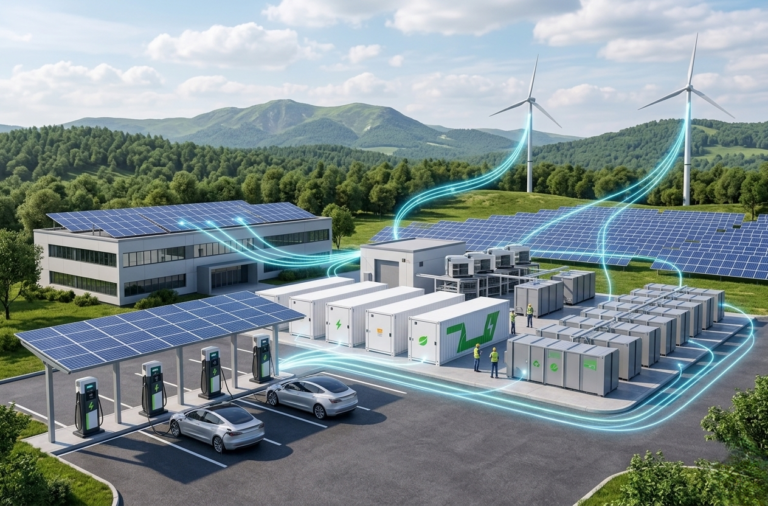
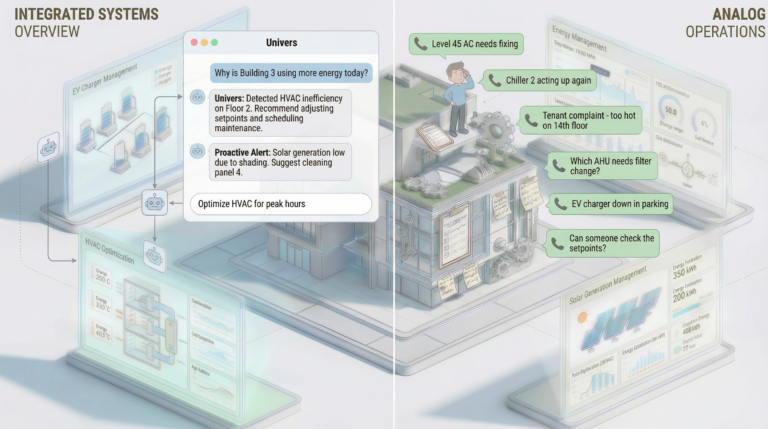
At Univers, advancing climate action and the global energy transition is closely connected to what we do. Our Platform for Physical AI helps organisations turn complex energy and infrastructure data into operational insights that inform action, playing a practical role in bridging sustainability ambition and execution. By optimising how energy and physical infrastructure are managed and operated, we enable more efficient, resilient and sustainable operations while making emissions outcomes measurable.
As of 31 December 20251, Univers managed a total of 1,005 GW of asset capacity on behalf of customers2, with the renewables capacity under management equivalent to approximately 19% of global renewable energy capacity3. Our solutions are estimated to enable the avoidance of 1,013 million tonnes of GHG emissions per year, calculated using the accounting methodologies set out in the Sustainability Report. This contribution was also recognised by the UN Global Compact Network Singapore (UNGCNS), which awarded Univers the Sustainable Solutions Award (non-SME) at the 2026 Apex Awards.
These outcomes demonstrate the scale of the impact that our solutions can deliver for customers. Combining our own experience of putting sustainability commitments into practice with the capabilities of our Platform for Physical AI, we are well-equipped to enable our customers to advance their sustainability goals and navigate many of the same challenges around data, measurement and implementation that we have encountered within our own business.
From Ambition to Implementation
As the global conversation at COP31 continues to focus on accelerating climate action, implementation remains a key challenge for businesses. While commitments matter, credibility ultimately depends on an organisation’s ability to put them into practice, measure progress and continue improving.
For Univers, that means continuing to strengthen our own sustainability performance while applying our technology and expertise to help customers navigate the energy transition. Our FY2025/26 Sustainability Report shows where we stand today, while recognising that there is always more work to do. Sustainability performance and the systems behind it need to keep evolving as our business grows, methodologies improve and expectations change.
Credible sustainability leadership therefore starts from within, but it does not end there. By strengthening our sustainability practices and the responsible use of AI within our own business, while applying our technology to help customers turn energy and sustainability data into operational action, we can contribute to the wider transition from ambition to measurable progress.
Learn more about sustainability at Univers and our latest progress on our sustainability website.
1 The capacity and avoided emissions data are collected on a calendar-year basis for the period from 1 January to 31 December 2025. This differs from the reporting period of this Sustainability Report, which covers the 15 months from 1 January 2025 to 31 March 2026.
2 As of the date of this article, Univers manages a total of 1,070 GW of asset capacity.
3 Based on the global 2025 solar, wind, hydro and geothermal capacity of 4,995 GW (Source: IRENA Renewable Capacity Highlights 2026).