

Your Smartest Building Still Runs on WhatsApp

You digitised your buildings. You didn’t digitise how you run them.
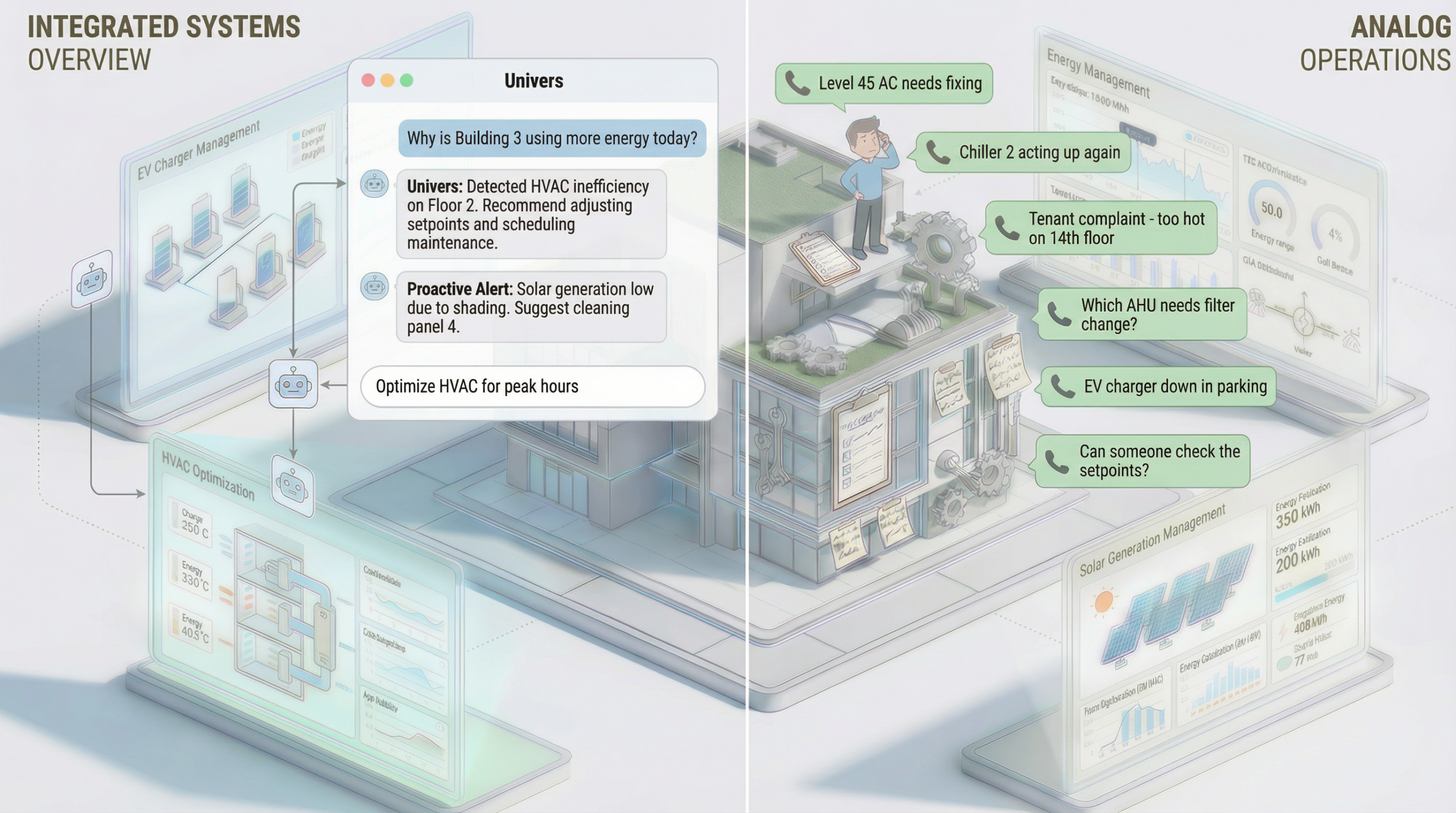
Somewhere right now, a facility manager is staring at a building management system that was programmed five years ago, manually adjusting chiller setpoints because a tenant called to say it’s too warm on the fourteenth floor. His phone has 47 unread messages in the building ops WhatsApp group — photos of fault codes, complaints forwarded from tenants, a contractor asking which AHU needs the filter change. The building has sensors on every floor. There’s a dashboard nobody opens.
Upstairs, someone just approved twelve EV chargers for the car park. Nobody checked whether the electrical infrastructure can handle the load.
This is the default operating model for most large building portfolios. It is about to break.
The ceiling isn’t energy. It’s operations.
The obvious efficiency gains have been captured. Lighting retrofits, equipment upgrades, BMS tuning — these delivered savings five years ago. Those returns are flattening. But the deeper problem isn’t that energy savings are harder to find. It’s that the operating model underneath cannot absorb what’s coming next.
Electrification is accelerating. Energy prices penalise *when* power is used, not just how much. Reporting requirements are shifting from voluntary to audit-grade. And through all of this, operations teams are asked to manage more sites, more systems and more complexity — with the same headcount they had five years ago.
You cannot hire your way out of this. The labour market for experienced building operators is shrinking across every region. When these people leave, their knowledge — which chiller acts up in high humidity, which valve sticks in winter, which floor always runs hot — walks out the door with them.
The energy waste on your utility bill is a symptom. The root cause is that every building in your portfolio is still run as an independent operation, with its own people, its own logic, and its own blind spots.
The regional picture
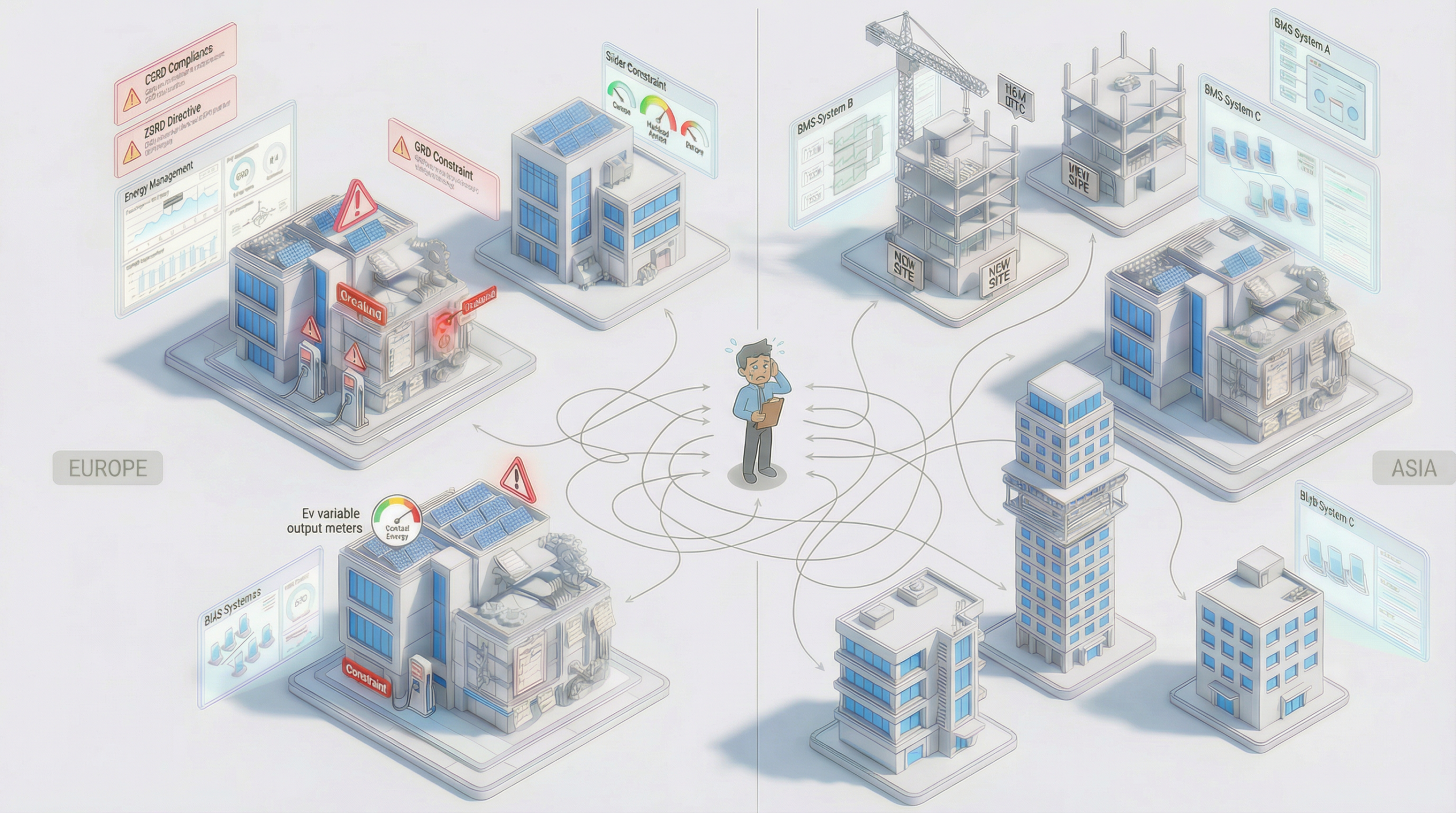
In Europe, the pressure comes from every direction at once. Electrification is outpacing grid reinforcement. Renewable variability swings building energy costs 30% between a sunny Tuesday and a grey Wednesday. CSRD, EPBD and taxonomy compliance pile regulatory workload onto teams that were already stretched. Electrify too quickly and you hit trapped capacity — you literally cannot add more chargers or cooling without infrastructure upgrades that take years.
In Asia, portfolio growth is the breaking force. New sites absorb quarterly across multiple cities and jurisdictions. Each has its own BMS, its own maintenance contractor, its own alarm logic. A facility manager who used to know every piece of equipment on one site is now covering five sites across two countries, managing by WhatsApp and tribal knowledge. He’s not incompetent — he’s under-equipped.
The failure mode is identical in both regions. Energy, maintenance, comfort and compliance are treated as separate problems. Each building is an island. The operations team is the ferry service — moving between islands, carrying information in their heads, reacting to whichever alarm is loudest.
Dashboards didn’t solve this. Agents will.
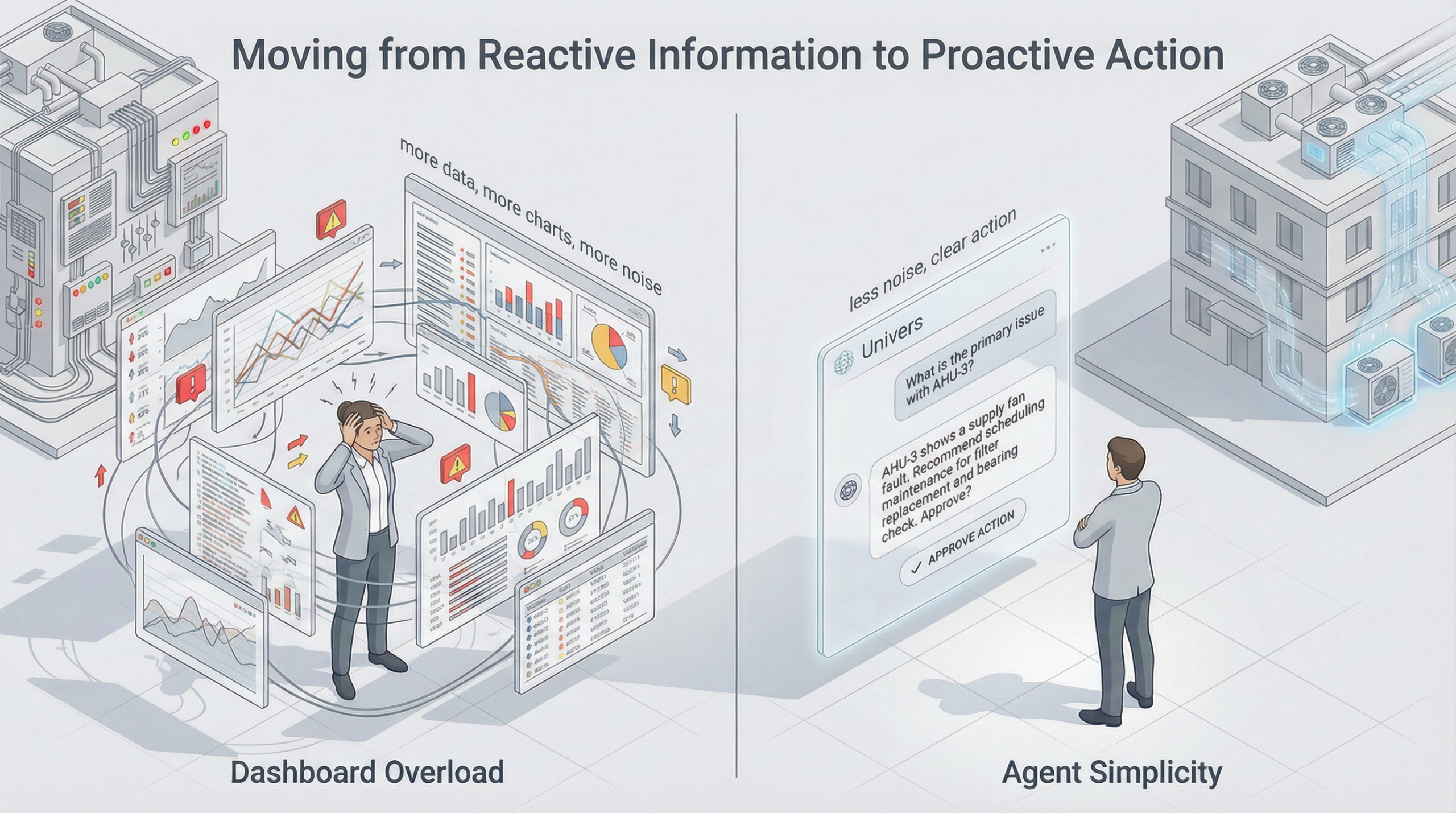
The first generation of smart building technology gave us dashboards. More visibility. More data. More charts. And largely, more noise.
The result is a facility manager who now has *two* problems: the original operational chaos, plus a screen full of data he doesn’t have time to interpret. Dashboards point at problems. They don’t resolve them. The operator still has to diagnose, decide and act — and he’s doing that across five buildings while the WhatsApp group keeps pinging.
The shift now underway is from information to action. From dashboards to agents.
An AI agent doesn’t show you that a chiller is underperforming. It diagnoses the root cause, identifies the corrective action, and either executes it autonomously or surfaces a specific recommendation that a human can approve in one tap. It doesn’t present a temperature trend chart — it reads tomorrow’s weather forecast, models the thermal load, and adjusts setpoints before the building drifts. It doesn’t generate an energy report — it answers a plain-language question: *”Which building consumed the most energy last month and why?”
This is the shift from reactive monitoring to outcome-based operations. The system doesn’t wait for a human to notice a problem. It senses, reasons, acts and verifies — continuously, across the portfolio, 24 hours a day. The human becomes an exception handler, intervening only when the system cannot resolve the issue itself.
The procurement world is already catching up. Large public sector portfolios are now writing tender specifications that explicitly require AI-powered conversational interfaces, predictive maintenance, self-healing asset control and outcome-based service delivery. The language has moved from “provide a dashboard” to “facilitate seamless communication using natural language with context awareness.” That’s not a reporting tool. That’s an agent.
The operating model shift
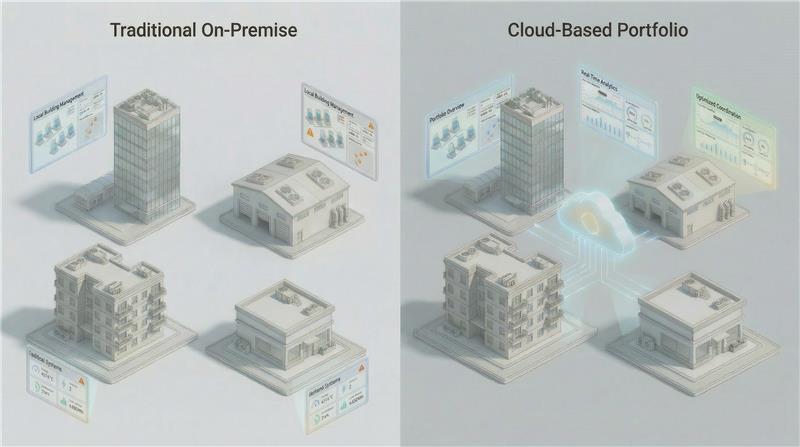
On-premise building management systems were designed for one building, fixed schedules and stable demand. They control equipment reliably. What they do not do is coordinate across sites, learn from patterns, anticipate problems, or adapt.
The BMS is the building’s hands. What’s missing is a brain that can see across the whole portfolio.
The shift is not about replacing legacy hardware. It’s about layering intelligence on top — a cloud-native operations layer that connects to existing BMS via open protocols, keeps buildings locally controlled, and enables portfolio-wide visibility, learning and orchestration.
Three principles define this:
- Centralise intelligence, distribute control. A central operations team gets full visibility — anomalies ranked by severity, maintenance prioritised by impact, energy decisions coordinated across sites. Not a dashboard that shows everything. A system that surfaces only what matters, and acts on the rest autonomously. The same team that managed fifteen buildings now manages forty.
- Predict, don’t react. Anticipate load shifts before the peak. Catch the failing pump three weeks before it stops. Deploy people to genuine exceptions, not routine rounds. One principle, three operational outcomes — energy, maintenance and staffing — unified under a single intelligence layer.
- Orchestrate the fleet, not the asset.** The unit of management moves from the individual building to the portfolio. A heatwave forecast doesn’t trigger pre-cooling in one building. It triggers a coordinated response across every building in the region, each contributing within its constraints.
Vendor lock-in is the wrong foundation
One more shift that matters: how this is procured.
The legacy model tied operators to a single vendor’s proprietary ecosystem — hardware, software, protocols, data. Switching costs were designed to be prohibitive. The result was buildings locked into platforms that aged faster than the contracts that governed them.
The next generation must be built on open standards. BACnet, Modbus, OPC UA — the protocol layer should be vendor-agnostic by design. Cloud platforms should operate as SaaS with clear data portability and contractual exit provisions. Intelligence should layer on top of existing infrastructure, not replace it.
This is not an abstract principle. It is becoming a procurement requirement. Forward-thinking portfolio operators are structuring contracts with mandatory exit plans, open API architectures and transition clauses that ensure the next contractor can take over within weeks, not years. The intelligence layer must be a service you choose to keep renewing — not a cage you can’t afford to leave.
The operating system for the physical world
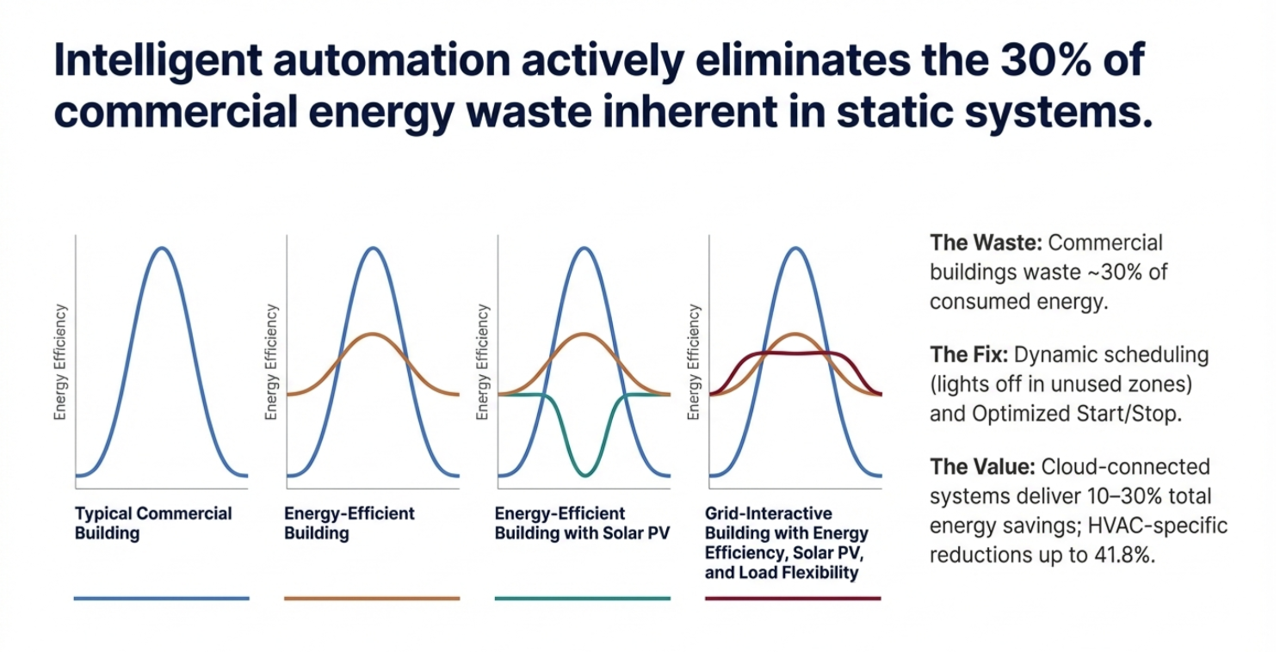
We are not optimising a utility bill. We are building the operating system that runs electrified portfolios: sensing conditions, predicting demand, anticipating failures, dispatching the right response, and making continuous trade-offs between cost, carbon, comfort and capacity — across every building, every hour, with fewer people and higher standards.
The organisations that see this — that the shift is from managing assets to orchestrating systems, from dashboards to agents, from vendor dependency to open platforms — will not just cut costs. They will be the ones capable of scaling electrification, absorbing growth, and running resilient operations in an environment that gets more complex every year.
The ones that don’t will keep hiring people to do what systems should.